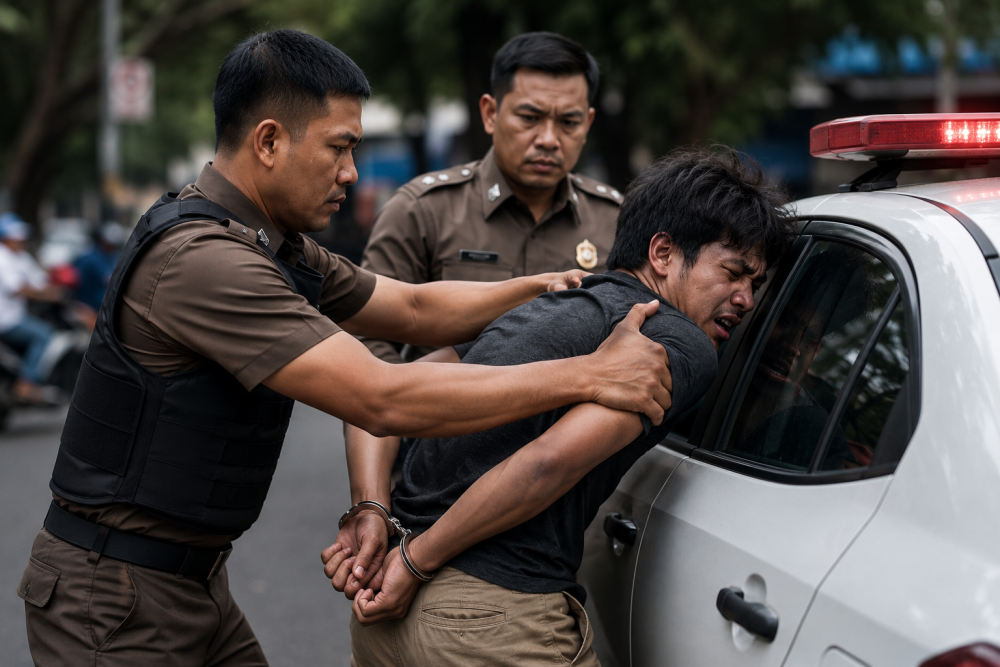

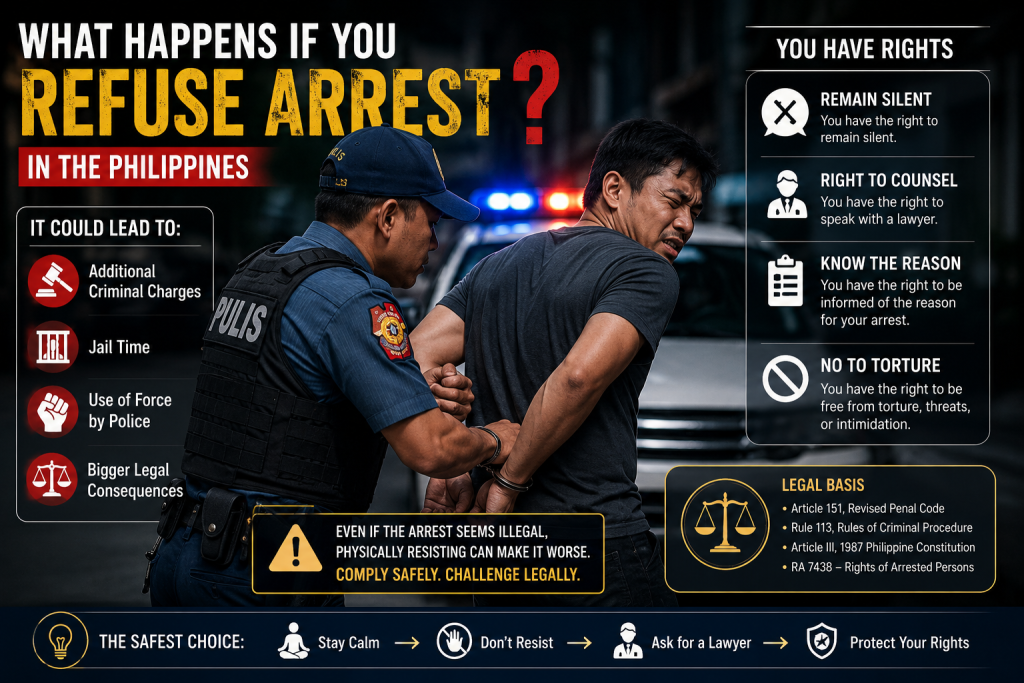
In the Philippines, refusing or resisting a lawful arrest can lead to additional criminal charges, including resistance and disobedience to a person in authority under Article 151 of the Revised Penal Code. Even if you believe the arrest is unfair or illegal, physically fighting police officers can worsen the situation and may result in jail time, injuries, or more serious criminal cases.
As of 2026, the safest approach during an arrest in the Philippines is usually to remain calm, avoid physical resistance, ask for a lawyer immediately, and challenge the legality of the arrest later through the courts.
Can You Legally Refuse Arrest in the Philippines?
You may verbally question or challenge an arrest, especially if you believe police have no legal basis. However, physically resisting a lawful arrest may itself become a criminal offense.
Many Filipinos mistakenly believe they can refuse arrest simply because:
- police have no warrant,
- they are innocent,
- officers are rude,
- they disagree with the accusation.
In reality, innocence does not automatically prevent arrest. Courts determine guilt later.
This is why lawyers often advise:
“Comply physically, resist legally.”
What Law Covers Resisting Arrest in the Philippines?
Several Philippine laws may apply during resisting arrest situations.
Article 151 of the Revised Penal Code
This covers:
- resistance,
- serious disobedience,
- refusal to obey lawful police orders.
Police officers are considered agents of persons in authority while performing official duties.
Rule 113 of the Rules of Criminal Procedure
This governs arrests in the Philippines, including warrantless arrests.
Article III of the 1987 Philippine Constitution
This protects constitutional rights during arrests, including:
- due process,
- protection against unreasonable searches,
- right to counsel,
- right to remain silent.
RA 7438
This law protects the rights of arrested and detained persons, especially during custodial investigation.
What Counts as “Resisting Arrest”?
Many people imagine resisting arrest as punching a police officer. But in real-life Philippine cases, resistance can include smaller actions.
Examples include:
- pulling away during handcuffing,
- refusing to enter a patrol vehicle,
- running from police,
- physically blocking officers,
- encouraging others to interfere,
- refusing lawful booking procedures,
- struggling during checkpoint detention,
- grabbing police equipment.
In some situations, even minor resistance can escalate police response very quickly.
Real-Life Example
A person involved in a simple bar altercation in Makati may initially face only a disturbance complaint. But if he shoves an officer during arrest, prosecutors may later add:
- resistance and disobedience,
- direct assault,
- physical injuries.
The legal situation can become far more serious within seconds.
Can Police Arrest You Without a Warrant in the Philippines?
Yes. Philippine law allows warrantless arrests under limited situations.
Under Rule 113, Section 5 of the Rules of Criminal Procedure, police may arrest without warrant in these common situations:
| Situation | Can Police Arrest Without Warrant? |
|---|---|
| Crime witnessed directly | Yes |
| Hot pursuit after crime | Yes |
| Escaped prisoner | Yes |
| Anonymous accusation only | Usually no |
| Inside private home without exception | Usually no |
| Traffic violation only | Depends on circumstances |
In Flagrante Delicto Arrest
Police personally witness the crime happening.
Examples:
- assault in public,
- drug transaction,
- drunk driving accident,
- public disturbance.
Hot Pursuit Arrest
Police reasonably believe a person committed a crime that just occurred.
Example:
- robbery suspect identified immediately after fleeing.
Escaped Prisoner Exception
Escaped detainees may be arrested immediately without warrant.
What Happens If You Refuse Arrest During a Traffic Stop?
This is one of the most searched scenarios in the Philippines.
Common situations include:
- DUI checkpoints,
- motorcycle violations,
- reckless driving stops,
- no license apprehensions,
- coding or registration violations.
If police attempt an arrest and the driver:
- refuses to step out,
- drives away,
- physically struggles,
- threatens officers,
additional criminal complaints may follow.
As of 2026, many Philippine checkpoint operations also use body cameras and cellphone recordings, which may later become evidence.
What Usually Happens During Arrest in the Philippines?
Real-life arrests in the Philippines often follow a predictable pattern.
Step-by-Step Arrest Timeline
1. Initial Encounter
Police contact may happen:
- during a checkpoint,
- after a fight,
- through a warrant operation,
- after a traffic accident,
- after a barangay complaint,
- during anti-drug operations.
2. Physical Arrest
Police may:
- handcuff the suspect,
- conduct a body search,
- place the suspect inside a patrol vehicle.
If resistance occurs, officers may use reasonable force to control the situation.
3. Transport to Police Station
Many suspects are brought first to:
- the barangay,
- precinct station,
- city police headquarters.
In Metro Manila, this process may happen quickly after warrantless arrests.
4. Booking Procedure
This commonly includes:
- recording personal information,
- fingerprints,
- mugshots,
- inventory of belongings,
- medical examination in some cases.
Phones may temporarily be held during booking.
5. Inquest Proceedings
For warrantless arrests, prosecutors usually conduct an inquest to determine whether charges proceed.
This may happen:
- within the same day,
- overnight,
- the following morning depending on circumstances.
6. Bail or Continued Detention
Some offenses are bailable.
More serious cases may require court hearings first.
7. Court Proceedings
If charges continue, the process may include:
- arraignment,
- pre-trial,
- hearings,
- trial.
What Should You NOT Say During Arrest?
Many arrests escalate because of panic or emotional reactions.
Avoid statements like:
- “I will fight you.”
- “You cannot arrest me.”
- “Do you know who I am?”
- “I know powerful people.”
- false confessions made under pressure.
Instead:
- remain calm,
- ask for a lawyer,
- state clearly that you wish to remain silent.
What Are Your Rights During Arrest?
Under Philippine law, arrested persons have constitutional rights.
Miranda Rights in the Philippines
You generally have the right to:
- remain silent,
- competent legal counsel,
- know the reason for arrest,
- avoid torture or intimidation,
- communicate with family or lawyer.
Police cannot legally force confessions through violence or coercion.
Can Police Hit You During Arrest?
Police may use reasonable force if:
- the suspect fights officers,
- attempts escape,
- creates immediate danger.
However, excessive force may expose officers to:
- administrative sanctions,
- criminal complaints,
- human rights investigations.
This is why many Filipinos search:
- “Can police beat suspects Philippines?”
- “Can police slap you during arrest?”
- “Can police use force during arrest?”
The legality depends heavily on proportional force and immediate danger.
Can Police Shoot You If You Resist Arrest?
Police may use deadly force only in extreme situations involving serious danger to life or major threats to public safety.
If a suspect:
- points a weapon,
- attacks officers,
- creates immediate deadly danger,
officers may respond with force.
However, unjustified shootings may expose officers to:
- criminal liability,
- administrative sanctions,
- public investigations.
What If the Arrest Was Illegal?
This is one of the most important legal issues in the Philippines.
An arrest may become questionable if:
- police had no warrant and no legal exception,
- officers entered a home illegally,
- evidence was planted,
- excessive force was used,
- the wrong person was arrested.
Still, physically resisting often creates bigger legal risks.
The safer approach is usually:
- comply peacefully,
- remain silent,
- request legal counsel,
- challenge the arrest later.
Possible legal remedies include:
- filing complaints before the CHR,
- administrative complaints,
- habeas corpus petitions,
- suppression of illegally obtained evidence.
Supreme Court Reminder on Illegal Arrests
Philippine courts have repeatedly emphasized constitutional protections during arrests.
In several Supreme Court rulings involving unlawful arrests and illegal searches, the Court stressed that police officers must strictly follow constitutional safeguards and proper arrest procedures.
This remains a major issue in Philippine criminal cases even in 2026.
Can You Refuse Handcuffs in the Philippines?
No. Physically resisting handcuffing during a lawful arrest may lead to additional criminal charges.
Can You Record the Police During Arrest?
Generally, yes, especially in public places.
Examples include:
- checkpoints,
- traffic stops,
- public arrests,
- roadside incidents.
But recording should not:
- obstruct police operations,
- physically interfere,
- create safety risks.
Many viral arrest cases in the Philippines later rely heavily on cellphone footage.
Can Barangay Tanods Arrest Someone?
Barangay tanods have limited authority and usually assist police officers.
They may temporarily restrain suspects in some situations, especially during ongoing disturbances, but major criminal arrests are generally handled by the PNP.
What Happens If You Run From Police?
Running may:
- increase suspicion,
- trigger pursuit,
- escalate force,
- create additional charges.
Sudden flight during checkpoints or operations may also increase safety risks for everyone involved.
Can You Refuse Arrest If You Are Innocent?
No. Innocence alone does not automatically stop police from making an arrest.
Whether a person is guilty or innocent is decided later by prosecutors and courts.
This is why legal experts often recommend:
- avoid physical resistance,
- cooperate peacefully,
- challenge unlawful actions legally afterward.
What To Do If Police Try To Arrest You
Practical steps:
- Stay calm.
- Do not run.
- Avoid sudden movements.
- Do not physically resist.
- Ask why you are being arrested.
- Ask for a lawyer immediately.
- Do not sign documents you do not understand.
- Remain silent if unsure what to say.
- Try to remember names, badge numbers, and locations.
- If safe, ask someone nearby to record the incident.
FAQ
Can you go to jail for resisting arrest in the Philippines?
Yes. Resisting a lawful arrest may lead to criminal charges and possible jail time.
Can police arrest you without warrant in the Philippines?
Yes. Philippine law allows warrantless arrests in limited situations such as hot pursuit and crimes committed in front of officers.
Can police enter your house without a warrant?
Usually no, unless legal exceptions apply.
Can you sue police for illegal arrest?
Yes. Administrative, criminal, and civil remedies may exist depending on the situation.
Can police use force during arrest?
Yes, but only reasonable force under the circumstances.
Can you refuse handcuffs?
Physically refusing handcuffs during a lawful arrest may lead to additional charges.
What should you do during arrest?
Stay calm, avoid physical resistance, remain silent, and ask for a lawyer.
Refusing arrest in the Philippines can rapidly turn a stressful encounter into a much more serious criminal situation. Many cases that begin as minor incidents escalate because suspects panic, argue aggressively, run, or physically resist officers.
Even when an arrest later turns out illegal, physical resistance often creates additional risks that are harder to defend in court.
In most situations, the safer strategy is simple:
stay calm, protect your rights, avoid violence, and challenge unlawful police actions through proper legal channels afterward.
Need legal help after an arrest in the Philippines? Speaking with a qualified lawyer immediately may help protect your rights, improve bail outcomes, and reduce long-term legal complications.
Learn more about your rights and police powers:
https://legaltelegraph.com/can-police-enter-house-without-warrant-ph/
Comments are closed!