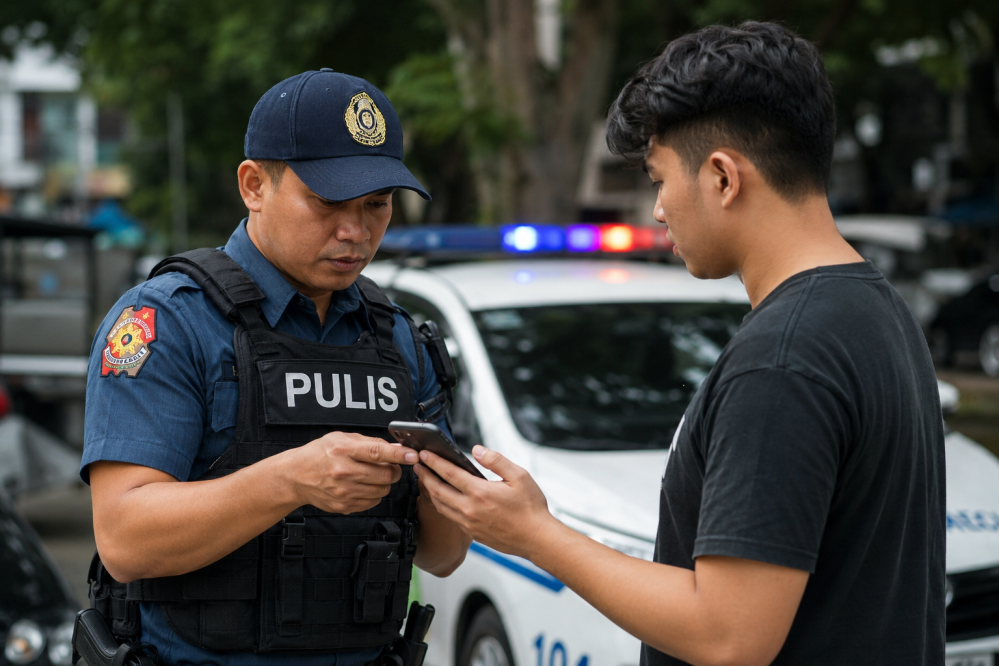

No, police in the Philippines cannot legally search your phone without a court-issued warrant, your explicit voluntary consent, or a lawful arrest where the phone is relevant evidence connected to a crime.
Legal Disclaimer: This article is for informational purposes only and does not constitute legal advice. For specific legal concerns or criminal cases, consult a licensed attorney in the Philippines.
Quick Summary: Phone Search Legality in the Philippines (2026)
| Situation | Can Police Search Your Phone? | Legal Requirement |
|---|---|---|
| Routine checkpoint | ❌ Usually no | Requires warrant, consent, or probable cause |
| Simple traffic violation | ❌ No | Traffic stop alone is insufficient |
| Under lawful arrest | ✅ Limited search possible | Rule 126, Section 13 may apply |
| Cybercrime investigation | ✅ Possible | Usually requires judicial authorization |
| Voluntary consent | ✅ Yes | Your permission may waive privacy protections |
| Anti-terror investigation | ✅ Expanded powers possible | Subject to national security procedures |
| Phone visibly showing a crime | ✅ Possible seizure | Plain View Doctrine may apply |
Can Police Search Your Phone in the Philippines? Your Rights Explained (2026)
Smartphones now contain nearly every aspect of a person’s life. Banking apps, private chats, Messenger conversations, Telegram groups, work emails, photos, passwords, e-wallets, and social media accounts are all stored inside a single device.
That is exactly why cellphone searches have become one of the most legally sensitive issues in the Philippines.
Many Filipinos believe police officers can instantly inspect a phone during a checkpoint, traffic stop, or investigation. In reality, Philippine law places major constitutional limits on when authorities may legally access digital information.
In most situations, police cannot freely search your phone without a valid warrant, lawful arrest, or your direct consent. However, there are important exceptions involving cybercrime investigations, anti-drug operations, terrorism-related cases, and evidence plainly visible on the device itself.
What Philippine Law Says About Phone Searches
Several Philippine laws and constitutional protections govern cellphone searches and digital privacy.
1. The 1987 Philippine Constitution
Article III of the Constitution protects Filipinos against:
- Unreasonable searches and seizures
- Illegal warrantless searches
- Privacy violations
- Unlawful government intrusion
Section 2 specifically requires search warrants to be supported by probable cause personally determined by a judge.
This constitutional protection increasingly applies to smartphones because modern phones contain enormous amounts of personal and sensitive information.
2. Article III, Section 3 and the Exclusionary Rule
One of the strongest protections for Filipinos is found under Article III, Section 3 of the Constitution.
This establishes the Exclusionary Rule, which generally makes illegally obtained evidence inadmissible in court.
Lawyers often describe this principle as:
- “Fruit of the poisonous tree”
In simple terms, if police illegally access your phone, the evidence extracted from that unlawful search may potentially be excluded from criminal proceedings.
Examples may include:
- Illegally accessed Messenger chats
- Unauthorized screenshots
- Improper forensic extraction
- Unlawfully copied files
- Private photos obtained without legal basis
This constitutional safeguard is one reason warrantless phone searches remain heavily scrutinized in the Philippines.
3. Data Privacy Act of 2012 (RA 10173)
The Data Privacy Act strengthened protections over:
- Personal information
- Sensitive data
- Digital communications
- Electronic records
- Online accounts
Although the law mainly regulates data handling and privacy standards, it reinforces the expectation that private digital information deserves protection from unlawful access.
4. Cybercrime Prevention Act (RA 10175)
The Cybercrime Prevention Act grants investigators broader authority in cases involving:
- Online scams
- Identity theft
- Hacking
- Fraud
- Cyber libel
- Illegal access to systems
However, cybercrime investigations still generally require proper judicial authorization before extensive forensic extraction of phone data may occur.
Can Police Search Your Phone Without a Warrant?
In most ordinary situations, no.
Police officers generally cannot randomly inspect:
- Messenger conversations
- Telegram chats
- Viber messages
- Banking apps
- Emails
- Photos and videos
- Cloud storage
- Social media accounts
without:
- Your voluntary consent
- A valid search warrant
- A lawful arrest connected to criminal activity
This is one of the most misunderstood legal issues in the Philippines.
Simply confiscating or physically holding a phone does not automatically grant unlimited legal access to everything inside the device.
Can Police Search Your Phone at a Checkpoint?
Routine checkpoints do not automatically authorize cellphone searches.
Police officers may legally request:
- Driver’s license
- Vehicle registration
- Identification documents
But without probable cause, authorities generally cannot:
- Scroll through your phone
- Read private messages
- Open social media apps
- Browse your gallery
- Demand passwords
- Force facial recognition unlock
unless you voluntarily consent.
What Is Probable Cause?
Probable cause means officers have reasonable grounds to believe:
- A crime was committed
- Evidence exists on the device
- The phone is connected to criminal activity
Examples may involve:
- Drug operations
- Cybercrime complaints
- Online scam investigations
- Extortion cases
- Terror-related offenses
What Is the Plain View Doctrine?
The Plain View Doctrine is an important legal exception frequently discussed in search-and-seizure cases.
Under this doctrine, police may seize evidence that is openly visible during a lawful encounter.
For example:
- An open drug transaction visible on the screen
- Threat messages already displayed
- Scam communications openly visible
- Illegal content displayed publicly
may potentially justify seizure of the device.
However, the doctrine does not automatically permit unlimited browsing through all files, apps, and private communications stored inside the phone.
Can Police Force You to Unlock Your Phone?
Philippine law remains legally unsettled regarding compelled phone unlocking.
In practice, police may ask you to:
- Enter your PIN
- Provide passwords
- Use fingerprint unlock
- Use facial recognition
But in many ordinary situations, you may legally refuse if there is no warrant or lawful basis.
The situation becomes far more serious during:
- Lawful arrests
- Anti-drug operations
- Cybercrime investigations
- Anti-terror operations
At that point, investigators may seek judicial authority or attempt forensic extraction procedures.
Search Incidental to a Lawful Arrest Explained
One of the biggest exceptions to warrant requirements involves searches incidental to lawful arrest.
This authority comes from Rule 126, Section 13 of the Revised Rules on Criminal Procedure.
Under this rule, police may search:
- The arrested person
- Objects immediately connected to the arrest
- Potential evidence linked to the offense
If investigators believe the cellphone contains evidence directly related to the alleged crime, officers may seize the device.
Examples include:
- Drug transaction records
- Fraud communications
- Scam evidence
- Threat messages
- Illegal payment records
However, many legal experts argue that deep forensic extraction of a smartphone should still require separate judicial authorization because phones contain large amounts of unrelated private information.
Can Police Read Messenger, Telegram, or Viber Messages?
Not automatically.
Private digital communications often receive stronger privacy protection than ordinary physical evidence.
Authorities generally need legal authority before deeply examining:
- Facebook Messenger
- Telegram
- Viber
- Gmail
- Cloud backups
- Social media accounts
especially when the information is remotely stored or involves private communications.
Can Police Confiscate Your Phone?
Yes, under certain circumstances.
Police may temporarily seize a device if they believe it is connected to:
- Criminal evidence
- Illegal activity
- Ongoing investigations
- Cybercrime operations
The device may then undergo:
- Evidence inventory procedures
- Digital preservation
- Chain-of-custody documentation
- Forensic examination
However, confiscation alone does not automatically permit unrestricted access to all information stored inside the phone.
2025-2026 Updates in Philippine Digital Evidence Law
2025 Supreme Court Ruling on Social Media Account Ownership
A major 2025 Supreme Court ruling, XXX v. People (G.R. No. 274842, October 2025), established stricter guideposts for proving ownership and control of social media accounts used as evidence in criminal proceedings.
The ruling emphasized that investigators must properly establish:
- Account ownership
- Device control
- Authenticity of digital records
- Reliability of extracted evidence
- Proper attribution of online activity
This became increasingly important in cybercrime and online fraud prosecutions.
New PNP Digital Evidence Protocols in 2026
In early 2026, the Philippine National Police adopted updated procedures involving social media and electronic evidence handling.
The protocols reportedly focused on:
- Chain-of-custody requirements
- Digital evidence preservation
- Proper forensic extraction
- Documentation standards
- Authentication procedures
These changes reflect how central smartphones have become in modern criminal investigations.
The Biggest Mistake: Voluntary Consent
Many Filipinos unknowingly weaken their own legal protections by voluntarily allowing searches.
Statements such as:
- “Okay, check it.”
- “I have nothing to hide.”
- “Sure, go ahead.”
may later be interpreted as voluntary consent.
Once consent is given, challenging the legality of the search becomes significantly harder.
What To Do If Police Ask To Search Your Phone
Knowing how to respond calmly and properly is extremely important.
Stay calm
Do not physically resist officers.
Ask respectful questions
You may calmly ask:
- “Do you have a warrant?”
- “Am I under arrest?”
- “Am I legally required to unlock my phone?”
Do not delete files
Deleting potential evidence during an investigation may create additional legal problems.
Remember important details
Take note of:
- Officer names
- Badge numbers
- Time and location
- Witnesses present
Contact a lawyer immediately
Especially if:
- Your phone was confiscated
- Passwords were demanded
- You were detained
- Accounts were accessed
People Also Ask
Can police force me to give my phone password in the Philippines?
In many ordinary situations, police cannot automatically compel you to provide passwords without lawful authority or judicial approval.
Is refusing a phone search illegal in the Philippines?
Not necessarily. Refusing a search without a valid warrant or lawful basis is generally not a crime by itself.
Can police search your phone during a traffic stop?
A simple traffic stop alone usually does not authorize a full cellphone search.
Can police read deleted messages?
Possibly. Digital forensic tools may recover deleted chats, screenshots, files, and cloud-stored information.
Can NBI agents search phones?
The National Bureau of Investigation generally follows similar constitutional and warrant requirements during investigations.
Can police use chats and screenshots as evidence?
Yes. Messages, screenshots, and digital records may be used as evidence if legally obtained and properly authenticated.
Can airport authorities inspect your phone in the Philippines?
Airport security may inspect devices for security purposes, but deep access to personal data raises additional constitutional and privacy concerns.
Police in the Philippines do not have unlimited authority to inspect your cellphone. In most situations, your device remains protected by constitutional privacy rights, warrant requirements, and rules against unreasonable searches.
However, lawful arrests, cybercrime investigations, consent, and national security operations can significantly change the legal landscape.
One of the most important things Filipinos should understand is this: voluntarily giving police access to your phone may weaken your ability to later challenge the legality of the search.
If officers attempt to inspect or confiscate your device, remaining calm and immediately seeking legal advice is usually the safest course of action.
Read the blog LegalTelegraph!